
Public Sector Equality Duty Report 2025 - 2026
Introduction by Assistant Chief Officer Paul Bullen
Public trust and confidence are the key driver for policing. Improving trust and confidence is central to Northamptonshire Police’s policing plan. We know that having an organisation that is representative of all the communities of Northamptonshire will improve trust and confidence through having people in the organisation that everyone can identify with.
Northamptonshire Police is an organisation that is for all the communities of the county and strives to be as representative of those communities as it can be. We know there is a journey still to go to achieve that, but we remain committed to breaking down barriers that prevent anyone from being a police officer or staff member, or from receiving service from the organisation that falls below that which we would all want it to.
I am proud of the changes that this document shows we have implemented that have made a difference. Even small changes can impact on individuals and each of the initiatives that this document outlines have contributed and made a difference. The improvements in gender balance are pleasing, although of course there remains much to be done in more senior police officer ranks (with work underway to support that), and the work outlined in relation to the Police Race Action Plan, amongst other initiatives, are yet to deliver long term and sustainable change. We remain committed to addressing matters in relation to equality so that every person can bring their whole self to work, and every member of the public receives the best service from the organisation that we can.
Public Sector Equality Duty Report
Policing is about putting people first; our values and approach commit us to a service of a consistently high quality. Key components of that service are that it is accessible, responsive, and visible and treats people with fairness, respect, and dignity.
The delivery of a quality service is our first and foremost priority. We are in the process of transforming many of the services we provide, and we want to make sure that what we do meets the needs of our different customers.
The Public Sector Equality Duty (PSED)
The PSED came into force on 5 April 2011. It is fundamental to the Equality Act and ensures that all public bodies "play their part in making society fairer by tackling discrimination and providing equality of opportunity for all".
The PSED has three aims. It requires public bodies to have due regard to the need to:
- eliminate unlawful discrimination, harassment, victimisation, and any other conduct prohibited by the Act.
- advance equality of opportunity between people who share a protected characteristic and people who do not share it.
- foster good relations between people who share a protected characteristic and people who do not share it.
The PSED requires us to consider the needs of all individuals - in shaping policy, in designing and delivering services, and in relation to our workforce.
It supports good decision-making by encouraging us to understand how different people will be affected by our activities so that policies and services are appropriate and accessible to all and meet different people's needs. By understanding the effect of our activities on different people, and how inclusive services can support and open people's opportunities, we are better placed to deliver policies and services that are efficient and effective. The PSED therefore helps us to deliver the Government's overall objectives for public services and our aim to have a Police Service fit for the future.
The PSED covers the following protected characteristics:
- Age
- Disability
- Gender reassignment
- Pregnancy and maternity
- Race (this includes ethnic or national origina, colour, or nationality)
- Religion or belief (this includes lack of belief)
- Sex (gender)
- Sexual orientation
It also applies to marriage and civil partnership, but only in respect of the requirement to have due regard to the need to eliminate discrimination.
What does 'due regard' mean?
It means consciously thinking about the three aims of the Equality Duty as part of the decision-making process. Consideration of equality issues must influence our decisions - such as in how we function as employers; how we develop, evaluate and review policy; how we design, deliver and evaluate services, and how we commission and procure from others.
Having due regard to the need to advance equality of opportunity involves considering the need to:
- remove or minimise disadvantages suffered by people due to their protected characteristics.
- meet the needs of people with protected characteristics.
- encourage people with protected characteristics to participate in public life or in other activities where their participation is low.
Having due regard to fostering good relations involves tackling prejudice and promoting understanding between people who share a protected characteristic and others.
Complying with the Equality Duty may involve treating some people better than others, as far as this is allowed by discrimination law. For example, it may involve making use of an exception or the positive action provisions to provide a service in a way which is appropriate for people who share a protected characteristic.
The PSED and decision-making
We need to consciously (but proportionately) think about the three aims of the PSED as part of the process of decision-making. The PSED will be one of several factors that need to be considered. Its weight, compared to the other factors, will depend on how much that function affects discrimination, equality of opportunity and good relations and the extent of any disadvantage that needs to be addressed.
Understanding our workforce and community is a part of the duty and we commit to providing this data annually. We also share our goals and aim so that you, the public, can gauge our progress. We have also added data that we hold about our victims so we can better understand how we reflect the community we serve, and we will continue to build on this data in future years.
Equality and Wellbeing Impact Assessments (EWIA)
As a public authority, Northamptonshire Police are responsible for making a wide range of decisions which can impact on specific groups and individuals. This includes policy procedures and relevant projects. To ensure the organisation can evidence ‘due regard’ an Equality and Wellbeing Impact Assessment (EWIA) is completed. The EWIA is a way of considering the effect that our proposals may have on diverse groups protected from discrimination by the Equality Act 2010. Completing an EWIA ensures consideration has been given to potential consequences and impacts and that any negative impacts are fully explained, mitigated/reduced or subject to appropriate justification. EWIAs are subject to regular reviews and updated whenever a policy, procedure or project is subject to change. The EWIA supports the three aims of the general duty of the Equality Act 2010 already listed above.
Understanding our workforce consultation
Is your future with us – recruitment and retention project
Significant work has been undertaken to improve retention by strengthening the recruitment, onboarding, and early service experience. Recruitment materials have been reviewed to better reflect the modern realities of policing, including the broader societal role officers play in mental health crises and domestic abuse. This has been supported using talks and insights from serving officers, ensuring candidates have a realistic understanding of the role from the outset. A more structured onboarding approach has been developed, incorporating video messages from senior leaders to set out organisational culture and priorities, alongside a recruitment charter to improve communication and engagement with candidates throughout the process. Targeted support has also been introduced for student officers, including the development of a ‘Student Officer Survival Kit’ to support wellbeing and adjustment during the probationary period.
To improve day to day experience and development, focus has been placed on the quality of line management, tutoring and workplace support. The tutoring process has been reviewed to improve consistency and ensure tutors demonstrate the right skills, ethics, and values, with increased awareness of differing learning styles and neurodiversity. The organisation has reinforced expectations around regular, high quality one to one meetings, ensuring managers are given the time and capability to support their staff effectively. Dedicated opportunities have been created for teams to build relationships and a sense of belonging, recognising the importance of feeling part of a policing “family,” particularly for newly posted officers.
Wellbeing and morale have been key priorities. Senior leaders have increased their visibility through “on the floor” engagement events to listen to staff concerns, address issues directly and clearly articulate workforce priorities. Additional work has included reviewing flexible working arrangements in 24/7 environments to ensure fair and consistent application of policy, enhancing wellbeing training for managers, and exploring approaches such as reflective debriefing, trauma aware officer allocation, and psychological surveillance in high-risk areas. Work has also progressed to improve recognition of the contribution of younger in-service staff and to assess morale more effectively through future staff surveys.
Finally, activity has focused on fairness, inclusion, and the use of data to inform interventions. Promotion processes have been reviewed in response to concerns about perceived fairness and wellbeing related impacts on progression, with clearer communication around objectivity and eligibility. Enhanced use of qualitative and quantitative retention data is being embedded within governance structures, alongside further engagement with officers and staff from minority ethnic backgrounds to identify any additional barriers. The organisation has continued to build its skills database to better value wider skills held by the workforce, explored targeted interventions for those considering leaving but who may thrive elsewhere in the organisation, and commenced development of a single Attraction and Retention Strategy for 2026–2030 to align and sustain this work.
The specific duties require public bodies to prepare and publish one or more specific and measurable equality aims which will help them to further the three aims of the Equality Duty. The current Diversity, Equality & Inclusion Strategy 2020-2025 and measurable objectives are set out on the next page.
Diversity, Equality, and Inclusion Strategy 2020 - 2025
Our Aim
Northamptonshire Police aim to be an organisation that is truly representative of the diverse communities we serve. We will be inclusive and outward-looking in our engagement, working with partner agencies and the public to build services that are accessible to all. We aim to be an organisation that inspires the confidence of every community in our ability to deliver fair and effective policing.
We will be an organisation that is free from discrimination, where our staff treat everyone with respect, dignity and according to their needs and in line with our shared values.
Our Strategy
We recognise that we are stronger together. By working with partners, our communities, our support networks, and our staff, we will accept nothing less than becoming an institutionally inclusive organisation. We will achieve our aim by using a strategy which focuses upon two elements.
These two elements are:
Our Communities and Partners
Community Confidence
We will increase the confidence of all communities in Northamptonshire. We will be transparent and open, ensuring that our policing powers are used fairly and effectively, welcoming scrutiny of their use. We will identify any instance of disproportionality in our service delivery and address it. We will take ownership of our mistakes and learn from them, removing any institutional defensiveness.
Working with Others
We will work with communities, partners, independent advisory groups, and critical friends to develop a service that is accessible and responsive. We will learn from others and share best practice to improve our reach as an organisation and the service. We will build lasting relationships which continuously improve and better our organisation.
Understanding our Communities
We will learn to engage with all communities within the county in a manner that best suits them. We will strive to ensure that their voices are heard, and their concerns are listened to and understood. We will ensure that community engagement is a core part of our policing role. We will build stronger independent advisory groups and other scrutiny panels which will help us better understand the impact of our service.
Tackling Prejudice and Hate
Working with our communities we will better understand the prejudice they face and how we can help eliminate it. We will work with partners to improve confidence in reporting hate crimes and incidents, providing better support to victims. We will improve the confidence of all our communities in Northamptonshire by delivering an effective and consistently high standard of investigation.
Our Organisation
Representative Workforce
We will use positive action and engagement to attract, recruit and retain people from a wide range of backgrounds and communities, creating a truly representative workforce. We will create an environment where people feel confident to disclose their protected characteristics and feel safe and valued for who they are. Our communities will see themselves reflected in our workforce.
Developing our Workforce
We will set our workforce up for success by building an environment and structure that provides equality of opportunity for everyone. We will support the development and progression of our workforce to ensure representation at all levels, creating an environment where people can be the best versions of themselves.
Our Culture
We will create a culture where people feel engaged, valued and a part of the organisation, enabling individuals to bring their whole self to work. We will develop a workforce that is motivated, ethical, engaged and takes ownership of issues to achieve success. We recognise that we are all leaders, who have a part to play in creating an institutionally inclusive organisation that will challenge and tackle prejudice and discrimination wherever it is found. Our leaders will be given the skills and knowledge to achieve our aims modelling the behaviours expected of a modern Police Force.
To meet the overall aim of our Diversity, Equality and Inclusion Strategy 2020 – 2025 outlined above, Northamptonshire Police has developed a set of four priorities to focus on in 2024-2025 based on our data, surveys, areas for improvement and DEI peer review. We have also started work on the new culture and Insight Strategy that was designed by the College of Policing. We have identified the priorities from this piece of work that we will be developing for the 2026-2027 review.
Our Priorities 2024 - 2025
Training and education
We will complete a bespoke training needs analysis and device a force wide training plan for mandatory learning which will include:
- Police Race Action Plan
- Code of Ethics
- Violence against Women and Girls (VAWG)
- Government Inquiries e.g. Stephen Port, Angiolini, Baroness Casey etc
We will work with other partners and forces to improve our training awareness and sharing best practice to deliver cultural competence.
Understanding & including our communities
All policies for diversity and inclusion and use of police powers are available for public scrutiny and feedback. We will work closely with Independent Advisory Groups to provide dynamic feedback and support for critical incidents.
We are committed to delivering the Police Race Action plan together with black communities of Northamptonshire, with the aim of building trust and confidence with black people in policing.
We will ensure all departments and teams priorities support community engagement activities, with clear objectives of how this supports wider DEI objectives.
Building a representative workforce
We will increase Positive Action offer to include:
- Career Academy to support police officers from under-represented groups that may face barriers in promotion processes
We will undertake internal research entitled 'Is your future with us' to examine the recruitment and retention of current staff to understand barriers, processes or practices that dissuade people from staying within the organisation.
We will continue development of leaders within the organisation, providing clear direction, training and advice that supports managers to assist and develop their own departments and teams in DEI awareness, challenging unacceptable behaviours and providing ethical and professional policing service.
Building an inclusive working environment
To embed the Code of Ethics within the organisation and encourage, listen to, and understand the views of others, seeking to recognise and respond to the physical, mental and emotional challenges that we and other may face.
Increase staff confidence reporting conduct and behaviours that are not aligned to an inclusive working environment, using the Integrity Reporting Line.
Develop ethical and inclusive ways for staff to challenge misogyny and discriminatory behaviour and supporting victims within the workplace and in the community. Increasing Allyship across the force supporting HeforShe force commitment.
To continue to engage with our workforce through informal and formal methods, including through the staff networks, to identify and remove barriers to equality of opportunity and ensure feedback informs change decisions and policy setting.
The areas of focus for 2025–2030, as outlined by the College of Policing, are grouped into two overarching categories: Working with the Public and Evolving the Organisation. Each category contains three specific areas of focus, detailed below.
For this reporting year, we have identified priority areas that will form the basis of our initial activity. This will allow us to define what success looks like and ensure that evaluation is built into our work so progress can be assessed in the next reporting cycle.
Working with the public
- Data and Information: The service will use relevant, high-quality data and information to understand disparity and take positive, evidence-based steps to address it
- Culture: The service will consistently demonstrate positive and meaningful engagement with local communities to build trust and confidence, fostering an inclusive culture
- Collaboration: The service will collaborate with community stakeholders, drawing on their lived experiences to shape inclusive policies and practices
Evolving the Organisation
- Data and Information: The service will use relevant, high-quality data and information to understand disparity and guide actions that actively address inequalities.
- Culture: The service will promote and maintain a workplace culture that is fair, respectful, and inclusive.
- Capability: The service will develop its workforce to ensure it has the confidence and skills needed to eliminate discrimination, promote equality of opportunity, and foster good relations.
A Positive Action Strategy was developed in autumn 2020 to support the Diversity, Equality, and Inclusion Strategy in striving to be a fully inclusive organisation where individuals can excel whilst being a true version of themselves.
Positive Action Strategy 2025 - 2030
The end of the Police Uplift Programme represented an opportunity to re-visit Northamptonshire Police’s Positive Action strategy to ensure that it aligned with the broad themes outlined in the People and Culture Strategy 2023 – 2027 and the following ambitions:
- Become a truly representative workforce.
- Become an institutionally inclusive organisation.
- Creating a culture where people feel engaged and valued.
- Building an environment that provides equality of opportunity for everyone.
- Developing a workforce that is motivated, ethical, and engaged.
- Challenge and tackle prejudice and discrimination.
To this end the Positive Action Strategy sets out what will be achieved and can be accessed via this link to consider it in detail: Positive Action | Northamptonshire Police
4.1 All Employees by Directorate
The table below shows the changes in staffing levels during 2024 compared to 2023.
| Directorate | Number of people 23/24 | Number of people 24/25 | Number of people 25/26 |
|---|---|---|---|
| Abstractions | 14 | 16 | 18 |
| Chief Officer Team (COT) | 49 | 53 | 54 |
| Central Operations | 177 | 206 | 560 |
| Central Services External | 7 | 7 | 5 |
| Citizens in Policing | 115 | 106 | 90 |
| Collaboration Units | 134 | 167 | 94 |
| Crime and Justice | 734 | 733 | 739 |
| Enabling Services | 411 | 407 | 446 |
| Local Policing | 979 | 972 | 687 |
| OPFCC | 123 | 136 | 152 |
| Operational Support | 78 | 84 | 95 |
| Student Officers | 62 | 39 | 65 |
| Supernumerary Posts | 15 | 11 | 11 |
| Grand Total | 2898 | 2937 | 3016 |
During the last 12 months, we have realigned the Force Control Room (including Initial Investigation, Telephone Investigation and Retail Crime team) from the Local Policing Command into the Operations Department (now called Integrated Operations). You will also note that the Collaboration Units number dropped in year - this is because Custody also moved from this command, into Operations as part of the same restructure.
4.2 All Employees by Pay Band
Table below shows the changes in rank and grade of employees
| Rank/Grade | Number of People 23/24 | Number of People 24/25 | Number of People 25/26 |
|---|---|---|---|
| Police Officers | 1526 | 1497 | 1500 |
| Chief Constable | 1 | 1 | 1 |
| Deputy Chief Constable | 1 | 1 | 1 |
| Assistant Chief Constable | 1 | 2 | 2 |
| Chief Superintendent | 4 | 5 | 5 |
| Superintendent | 13 | 12 | 15 |
| Chief Inspector | 23 | 27 | 28 |
| Inspector | 73 | 78 | 76 |
| Sergeant | 259 | 249 | 260 |
| Constable | 1151 | 1122 | 1112 |
| Staff & PCSOs | 1263 | 1340 | 1432 |
| PCC | 1 | 2 | 2 |
| CEO | 1 | 1 | 1 |
| ACO | 2 | 1 | 1 |
| PMG1-7 | 95 | 108 | 110 |
| SO1-2 | 309 | 359 | 339 |
| Scale 2-6 | 855 | 869 | 979 |
| Specials | 109 | 100 | 84 |
| Special Inspector | 1 | 0 | 0 |
| Special Sergeant | 14 | 13 | 9 |
| Special Constable | 94 | 87 | 75 |
| Grand Total | 2899 | 2937 | 3016 |
4.3 All Employees by Gender Split
&w=1024&h=336&scale=both&mode=max)
| Gender | PCSO | Police Officer | Special | Staff | Grand Total |
|---|---|---|---|---|---|
| Female | 35 (42% ↗) | 585 (39% ↗) | 23 (27% ↗) | 951 (71% ↗) | 1594 (52.5%) |
| Male | 49 (58%) | 915 (61%) | 61 (73%) | 397 (29%) | 1422 (47.1%) |
| Grand Total | 84 | 1500 | 84 | 1348 | 3016 |
4.4 Senior Employees by Gender Split
&w=1024&h=360&scale=both&mode=max)
| Gender | Senior Staff | Senior Officers | Grand Total |
|---|---|---|---|
| Female | 72 (63.16% ↗) | 37 (28.91% ↘) | 109 (45% →) |
| Male | 42 (36.84%) | 91 (71.09%) | 133 (55%) |
| Grand Total | 112 | 126 | 238 |
4.5 Senior Officer by Gender Split
&w=1024&h=337&scale=both&mode=max)
| Gender | Female | Male | Grand Total |
|---|---|---|---|
| CC/DCC | 0 (0% →) | 2 (100%) | 2 |
| ACC | 1 (50% →) | 1 (50%) | 2 |
| CSUPT | 1 (20% ↘) | 4 (80%) | 5 |
| SUPT | 5 (33.3% ↗) | 10 (66.6%) | 15 |
| CINSP | 10 (35.7% ↘) | 18 (64.2%) | 28 |
| INSP | 20 (26% ↘) | 56 (73%) | 76 |
| Grand Total | 37 (28.9%) | 91 (71.09%) | 126 |
4.6 Senior Staff by Gender Split
&w=1024&h=332&scale=both&mode=max)
| Gender | ACO | CEO | PCC | PMG | Grand Total |
|---|---|---|---|---|---|
| Female | 0 (0% →) | 0 (0% →) | 2 (100% →) | 70 (63.6% ↗) | 72 (63.1%) |
| Male | 1 (100%) | 1 (100%) | 0 (0%) | 40 (36.3%) | 42 (36.8%) |
| Grand Total | 1 | 1 | 2 | 110 | 114 |
Gender Data
Northamptonshire Police continue to make progress in improving gender representation and strengthening the culture, confidence and inclusion of both women and men across the organisation. Alongside our workforce data, a significant programme of engagement and events has taken place this year to support gender equality, raise visibility of lived experience, and foster constructive dialogue with our communities and partners.
International Women's Data - Guildhall Northampton
To mark International Women’s Day, Northamptonshire Police and Northamptonshire Fire & Rescue Service hosted a large county-wide celebration event at the Guildhall in Northampton. Attendance was high, with a full room of colleagues, partners and invited schools, all brought together to recognise the history and progress of women in policing and fire across Northamptonshire.
The programme included guest speakers from across the services who shared personal reflections on leadership, challenge, and progress. A powerful video was shared featuring lived experience stories from women in the organisation, highlighting both the highs and the difficult moments of navigating a career in policing and fire as a woman. The feedback from attendees was overwhelmingly positive, noting the honesty, inspiration and connection created by the event.
The venue was also used to highlight the presence and work of HeForShe, Positive Action, and female leaders from across the organisation. Banners displayed stories, quotes, and career journeys, providing representation, insight, and visibility for women at different stages of their careers. Senior male leaders also attended, answered questions from the audience, and welcomed constructive challenge — demonstrating active allyship and a commitment to progress.
International Men's Day - University of Northampton
In November, Northamptonshire Police, Northamptonshire Fire & Rescue Service, and the University of Northampton jointly hosted an event to mark International Men’s Day. This event centred around men’s wellbeing, positive masculinity, and the value of supportive male role models in the workplace.
Speakers from Beyond Equality delivered the keynote session, introducing the themes and tools they will continue to develop with us throughout 2026 as part of the organisation’s Year of Allyship. This cross-service partnership highlighted the importance of creating spaces where men can engage in discussions about identity, challenge, and mental health, and where they can actively participate in building a more inclusive and respectful culture.
4.7 All Employees by Ethnicity
&w=1024&h=342&scale=both&mode=max)
These tables show the comparative data from 2023, 2024 and 2025.
| All Staff - Ethnicity 23/24 | ||
|---|---|---|
| White | 2677 | 92.4% |
| Asian | 57 | 2% |
| Black | 34 | 1.2% |
| Mixed | 51 | 1.8% |
| Other | 3 | 0.1% |
| Prefer not to say | 44 | 1.5% |
| Unknown | 32 | 1.1% |
| Total | 2937 | 100% |
| All Staff - Ethnicity 24/25 | ||
|---|---|---|
| White | 2718 | 92.54% |
| Asian | 52 | 1.77% |
| Black | 33 | 1.12% |
| Mixed | 57 | 1.94% |
| Other | 2 | 0.07% |
| Prefer not to say | 43 | 1.46% |
| Unknown | 32 | 1.09% |
| Total | 2937 | 100% |
| All Staff - Ethnicity 25/26 | ||
|---|---|---|
| White | 2787 | 92.41% |
| Asian | 53 | 1.76% |
| Black | 39 | 1.29% |
| Mixed | 62 | 2.06% |
| Other | 3 | 0.10% |
| Prefer not to say | 43 | 1.43% |
| Unknown | 29 | 0.96% |
| Total | 3016 | 100% |
4.8 All senior employees by ethnicity
&w=1024&h=339&scale=both&mode=max)
| All Senior Employees Ethnicity | Staff | Officers | Total |
|---|---|---|---|
| White | 44.03% (106) | 51.03% (124) | 94.65% (230) |
| Asian | 0.41% (1) | 0.41% (1) | 0.82% (2) |
| Black | 0.41% (1) | 0.41% (1) | 0.82% (2) |
| Mixed | 1.65% (4) | 0.82% (2) | 2.47% (6) |
| Prefer not to say | 0.82% (2) | 0.00% (0) | 0.82% (2) |
| Unknown | 0.00% (0) | 0.00% (0) | 0.00% (0) |
| Total | 47.33% (114) | 52.67% (128) | 100.00% (242) |
Police Race Action Plan
The Police Race Action plan: Improving Policing for Black People is a national plan which has been adopted by every Police Force in the Country. The aim of the plan is to increase trust and confidence in policing amongst the black communities, to address disparity through an explain or reform approach and, underpinning the whole plan, to embed an anti-racist stance.
The four workstreams of the plan are as follows:
- Black people and communities are properly represented within policing at all levels.
- Black people and communities are respected and treated in a fair and equitable way.
- Black people and communities are routinely involved in the governance of policing.
- Black people are not ‘under-protected’ and are properly supported as victims of crime and as vulnerable groups.
In Northamptonshire, our Black and Black heritage community accounts for 4% of our population (Census data 2021). The proportion of our internal Black and Black heritage staff and officers does not reflect this, so work continues via our positive Action team and recruitment teams aiming to improve this.
Chief Constable Ivan Balhatchet’s commitment to the plan, improving trust and confidence, and addressing disproportionality is reflected in the creation of a Police Race Action Team, which consists of the Force Silver lead for the plan, a full time Inspector and two team members.
Within the work being embedded through the Force via leaders/actions owners in every department, there is a comprehensive programme of training and Continuous professional development plans aimed at enhancing cultural competence and a better skill set in communication and understanding of our diverse differences and communities.
In addition, the Force’s Control Strategy, which sets out the operational thematic priorities of the force, has Structural Equality embedded throughout. The control strategy sets the long-term priorities for crime prevention, intelligence, reassurance, and enforcement. Having structural equality sitting as a cross-cutting priority means that fairness, impartiality, integrity, and respect are designed into everything we do, forming the basis of our policing activities, to achieve fair outcomes for all communities.
Our organisational data relating to the use of powers (up to end of Dec 2025) continues to show that Black heritage individuals are the most disproportionately impacted by powers which include:
- Stop and search
- Use of Force
- Taser
- Crime and Justice outcomes
In addition, this year the force has started to record vehicle stops to allow us to further scrutinise policing powers. All our policing powers are assessed at the strategic Structural Equalities Board, which meets quarterly to look at the data pictures under the “Explain or Reform” ethos of the plan.
Organisational change is being shaped by communities, internal representation advice and sharing of lived experiences and the national black workforce annual survey. The results of this engagement and feedback shapes our force-specific plan actions, as well as how we implement the nationally set actions. Next year is the start of the force progress assessments, which occur on a local level and a national level.
4.9 All employees by disability
Graph shows declarations 2024 v 2025 with over an 8% increase in confidence to declare
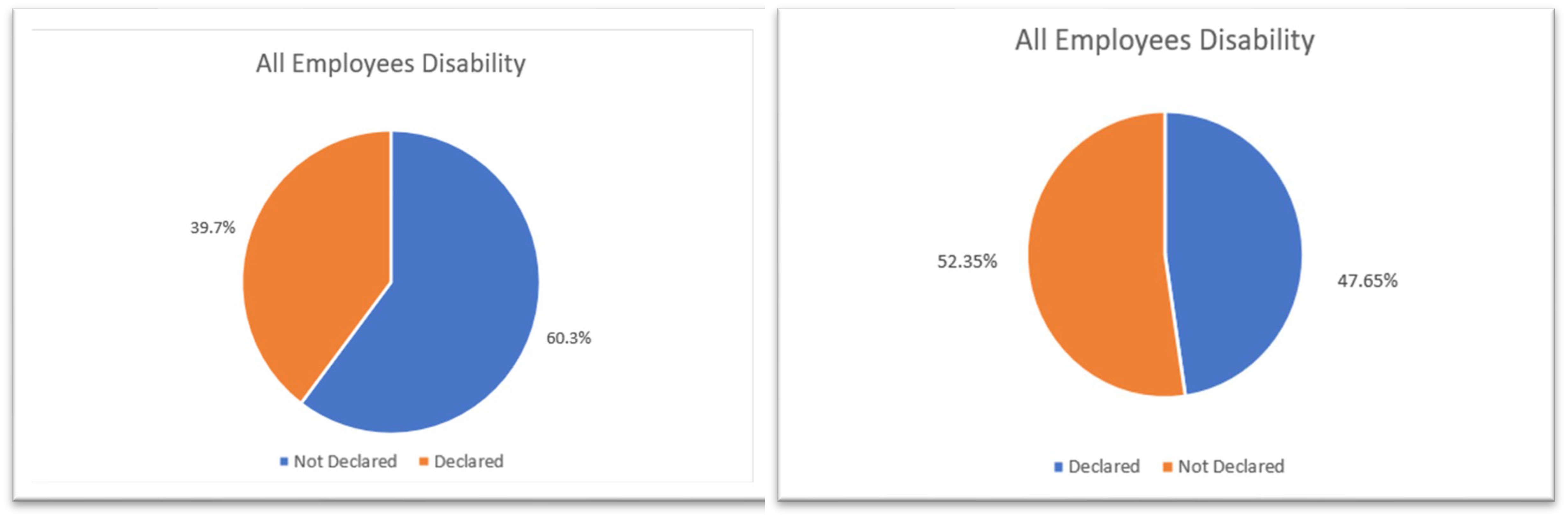
| Disability | PCSO | Police Officer | Special | Staff | Grand Total |
|---|---|---|---|---|---|
| Not Declared | 39 (46.43%) | 960 (64.00%) | 41 (48.81%) | 539 (44.24%) | 1579 (52.35%) |
| Declared | 45 (53.57% ↗) | 540 (36.00% ↗) | 43 (51.19% ↗) | 809 (62.04% ↗) | 1165 (47.65%) |
| Grand Total | 77 | 1497 | 100 | 1263 | 2937 |
4.9 All employees by disability - declared yes
&w=1024&h=336&scale=both&mode=max)
| Disability | PCSO | Police Officer | Special | Staff | Grand Total |
|---|---|---|---|---|---|
| Disability Declared (Yes) | 9 (10.71% ↗) | 124 (8.27% ↗) | 8 (10% ↗) | 149 (11.05% ↗) | 290 (9.62%) |
| Total Staff | 84 | 1500 | 84 | 1348 | 3016 |
4.10 Senior Employees by Disability
&w=1024&h=335&scale=both&mode=max)
| Rank/Role | Not Declared | % | Declared | % |
|---|---|---|---|---|
| CEO | 0 | 0.00% | 1 | 0.41% |
| ACO | 1 | 0.42% | 0 | 0.00% |
| PCC | 1 | 0.42% | 1 | 0.41% |
| PMG | 54 | 23.53% | 56 | 23.14% |
| CC/DCC | 0 | 0.00% | 2 | 0.83% |
| ACC | 2 | 0.84% | 0 | 0.00% |
| CSUPT | 2 | 1.26% | 3 | 1.24% |
| SUPT | 9 | 2.52% | 6 | 2.48% |
| CINSP | 22 | 10.08% | 6 | 2.48% |
| INSP | 59 | 24.79% | 17 | 7.02% |
| Grand Total | 150 | 61.98% | 92 ↗ | 38.02% |
4.10 Senior Employees by Disability - Declared Yes
&w=1024&h=337&scale=both&mode=max)
| Rank/Role | Disability Declared (Yes) | % |
|---|---|---|
| CEO | 0 | 0% |
| ACO | 0 | 0% |
| PCC | 0 | 0% |
| PMG | 9 | 3.70% |
| CC/DCC | 1 | 0.41% |
| ACC | 0 | 0% |
| CSUPT | 1 | 0.41% |
| SUPT | 2 | 0.82% |
| CINSP | 2 | 0.82% |
| INSP | 8 | 3.29% |
| Grand Total | 23 ↘ | 9.47% |
Over the past year, considerable progress has been made to improve the experience of disabled officers and staff across Northamptonshire Police. This work has focused on increasing trust in the organisation, improving the accuracy of disability data, strengthening support structures, and removing practical barriers that have historically affected disabled colleagues’ ability to thrive at work.
Improving Disability Declaration and Data Quality
Through the continued delivery of the Safe to Say campaign, the organisation has seen sustained improvement in disability declaration rates. This year, we achieved a further 8% increase in disability declarations, following a 10% increase the previous year. The campaign focused on transparency, education, and communicating clearly how declaration data is used to improve workplace support. Emphasis was placed on psychological safety and on explaining the benefits of disclosure, supported by real examples of positive change.
This improved data has directly informed decision making, including accessibility planning, facilities review, and the allocation of support resources.
Policy Reform for Hearing Loss
A major achievement this year was the reform of the force’s approach to supporting colleagues with hearing loss. Following engagement with disabled officers and staff, and analysis of Safe to Say data, the organisation introduced a new policy ensuring hearing aids damaged on duty are now fully covered, including above NHS replacement thresholds. This change removes a long-standing financial and operational barrier, improving fairness, and ensuring colleagues can work safely and confidently.
Strengthening Support Through the Disability Network
The Disability Network has expanded its role, introducing a peer support model to help colleagues with TRAAs, reasonable adjustments, and early-stage concerns. This approach provides relatable, lived experience informed support, and has reduced delays, uncertainty, and stress for individuals navigating adjustments. Network collaboration has also supported wider organisational improvements, including accessibility reviews such as evacuation planning for disabled staff.
Enhancing Disability Confidence Through Training and Culture Change
A review of disability related training was completed, ensuring content is accessible, neurodiversity friendly, and delivered in a way that builds confidence across the workforce. Work is underway to integrate disability inclusion more consistently into induction, CPD, and leadership development. This is supporting a broader cultural shift, with colleagues increasingly reporting improved understanding, empathy, and awareness of the lived experience of disability.
| 2025 | PCSO | Police Officer | Specials | Staff |
|---|---|---|---|---|
| Headcount | 84 | 1500 | 84 | 1348 |
| Ethnicity not provided | 0 | 16 | 5 | 19 |
| Ethnicity not provided % | 0.00% | 1.07%* | 5.95%* | 1.59% |
| Sexual orientation not provided | 20 | 315 | 20 | 125 |
| Sexual orientation not provided % | 23.81%* | 21%* | 23.81%* | 10.45%* |
| Religion not provided | 3 | 273 | 21 | 108 |
| Religion not provided % | 3.57%* | 18.20%* | 25%* | 9.03%* |
| Disability not provided | 39 | 960 | 41 | 498 |
| Disability not provided % | 46.43%* | 64%* | 48.81% | 41.64%* |
| 2024 | PCSO | Police Officer | Specials | Staff |
|---|---|---|---|---|
| Headcount | 77 | 1497 | 100 | 1263 |
| Ethnicity not provided | 0 | 19 | 6 | 7 |
| Ethnicity not provided % | 0.0% | 1.3% | 6.0% | 0.6% |
| Sexual orientation not provided | 23 | 349 | 25 | 145 |
| Sexual orientation not provided % | 29.9% | 23.3% | 25.0% | 11.5% |
| Religion not provided | 4 | 309 | 26 | 133 |
| Religion not provided % | 5.2% | 20.6% | 26.0% | 10.5% |
| Disability not provided | 44 | 433 | 41 | 658 |
| Disability not provided % | 57.1% | 71% | 41.0% | 52.1% |
| 2023 | PCSO | Police Officer | Specials | Staff |
|---|---|---|---|---|
| Headcount | 80 | 1526 | 109 | 1183 |
| Ethnicity not provided | 1 | 13 | 9 | 6 |
| Ethnicity not provided % | 1.3% | 0.9% | 8.3% | 0.5% |
| Sexual orientation not provided | 27 | 384 | 31 | 169 |
| Sexual orientation not provided % | 33.8% | 25.2% | 28.4% | 14.3% |
| Religion not provided | 5 | 335 | 33 | 158 |
| Religion not provided % | 6.3% | 22.0% | 30.3% | 13.4% |
| Disability not provided | 55 | 1193 | 80 | 739 |
| Disability not provided % | 68.8% | 78.2% | 73.4% | 62.5% |
The starred boxes see a marked improvement in declaration year on year.
4.11 All Employees by Sexuality
&w=1024&h=359&scale=both&mode=max)
| Sexuality | PCSO | Police Officer | Special | Staff | Grand Total |
|---|---|---|---|---|---|
| Bisexual | 2 (0.07%) | 49 (1.62%) | 2 (0.07%) | 33 (1.09%) | 86 (2.85%) |
| Gay/Lesbian | 3 (0.10%) | 52 (1.72%) | 2 (0.07%) | 40 (1.33%) | 97 (3.22%) |
| Other sexual orientation | 0 (0.00%) | 3 (0.10%) | 0 (0.00%) | 4 (0.13%) | 7 (0.23%) |
| Prefer not to say | 2 (0.07%) | 56 (1.86%) | 5 (0.17%) | 56 (1.86%) | 119 (3.95%) |
| Straight/Heterosexual | 57 (1.87%) | 1025 (33.99%) | 55 (1.82%) | 1080 (35.81%) | 2217 (73.51%) |
| Prefer to self describe | 0 (0.00%) | 0 (0.00%) | 0 (0.00%) | 0 (0.00%) | 0 (0.00%) |
| Not Stated | 20 (0.66%) | 315 (10.44%) | 20 (0.66%) | 135 (4.48%) | 490 (16.25%) |
| Grand Total | 84 | 1500 | 84 | 1348 | 3016 |
4.12 Senior Employees by Sexuality
&w=1024&h=337&scale=both&mode=max)
| Sexuality | Grand Total | |
|---|---|---|
| Heterosexual | 173 | 71.49% |
| Bisexual | 2 | 0.83% |
| Gay/Lesbian | 9 | 3.72% |
| Other | 1 | 0.41% |
| Prefer not to say | 12 | 4.96% |
| Prefer to self-describe | 0 | 0.00% |
| Not Stated | 45 | 18.60% |
| Grand Total | 242 | 100% |
The Organisation takes equality, diversity and human rights matters very seriously and is fully committed in ensuring that an equal, fair, and inclusive policing service is available to everyone. Northamptonshire police have a transgender and gender equality guidance document that equips officers and staff with the necessary knowledge of how to collaborate with colleagues who are going through transition. It also helps staff to understand their legal position in searching.
Confidentiality of this process is paramount ensuring trust is maintained and supportive measures are taken to protect individuals. While this currently only affects a small percentage of our workforce it is our belief that putting these measures in place safeguards all employees for the future and is necessary to improving our culture.
Case Study from Positive Action
'Schools Pipeline Project'
In November 2025, the Positive Action Team launched its ‘Schools Pipeline Project’ where groups of students from schools in Northamptonshire will be invited to visit a working police station where they can meet officers and staff and see the human side of policing.
The first students to visit were from Northampton International Academy, one of the most diverse schools in the county, and the trip helped cement the already strong ties the Positive Action Team has developed with the school.
Over 25 Year 11 students attended, and these included a mix of young people some of which had expressed an interest in joining the police and some who had a more complicated relationship with the organisation.
The group met the public desk staff, and they were shown the knife amnesty box, before seeing a presentation on modern policing, visiting the cells, visiting the police museum to see how policing had developed over the years, and chatting to PCSOs. They were then treated to a demonstration from the Dog Unit and came face to face with two working police dogs.
The Positive Action Team are looking to expand the offer moving forward with inputs from specialist ops such as firearms and detectives from CID.
The feedback from the day was overwhelmingly positive from the students, the staff who accompanied them, and from the officers and staff involved who had some of their preconceptions about teenagers challenged.
Staff support networks
The staff support networks continue to grow, confidence and reach, and they play a significant role in helping Northamptonshire Police create an inclusive, safe and supportive working environment for all employees. Over the past year, the networks have expanded their offer, increased engagement, and delivered initiatives that directly improve the lived experience of our workforce.
Gender, Women's and Men's Networks
The Gender Network has now evolved into a more focused network structure, with the creation of a dedicated Women’s Network and a Men’s Network currently being established.
Northamptonshire Police Women's Network
The new Women’s Network is accessible to all. This network focuses on supporting staff that are experiencing Menopause and Endometriosis, looks at mentoring and support and addresses fairness. This network will be fully launched in 2026 with a men’s network being launched separately also offering support offering the best range to all colleagues in the organisation addressing their individual needs. These networks take the place of the previous Gender Network acknowledging the need for both genders to be supported in their individual ways.
Northamptonshire Police Men's Network
The new Men’s Network will complement the Women’s Network by focusing on male wellbeing, health, peer support and allyship, ensuring all genders have a dedicated space where their needs are understood and supported. This is also due to be launched in 2026.
Northants Ethnic Minority Police Association (NEMPA)
Northants Ethnic Minority Police Association (NEMPA) is a support network for all persons from ethnic minority staff and officers. There is a lot of members who are not ethnic minorities themselves but push for diversity and equality within the Police. The network provides mentoring, a listening ear and support for officers who need assistance either in their personal lives or professionally.
Northamptonshire Association of Muslim Police (NAMP)
NAMP has delivered several well attended events across the county, including a multifaith Ramadan gathering in Northampton and a Diwali celebration in Wellingborough. These events brought our communities, leaders and officers together to learn about different faiths, celebrate together, and strengthen unity. They continue to be an excellent example of how shared cultural understanding strengthens policing relationships.
LGBT+ Network
During the last performance year, the LGBT+ Network have assisted the force in developing a Transgender & Gender Diversity Policy that aims to respect and accommodate those who identify differently from their birth-assigned gender, whilst complying with recent legal rulings around the definition of sex within The Equality Act. The LGBT+ Network also led on a LGBT+ community survey within Northamptonshire attracting responses from over 500 residents. This has been built into a report with recommendations for the force (and partners) to drive improvements on matters such like support for LGBT+ Domestic Abuse victims, and work is ongoing with stakeholders to shape this.
Disability Network
Our Disability Network has grown significantly in membership and influence this year. The network continues to drive meaningful change, including improvements to processes, stronger peer support, and increased visibility of disability inclusion across the organisation. Its work, alongside the Safe to Say campaign, has contributed to an additional 8% increase in disability declaration rates this year. This reflects rising trust and confidence in sharing protected characteristics, and we will continue to build on this progress in 2026. The network also provides practical support for TRAAs, reasonable adjustments and peer conversations, helping colleagues to navigate processes with confidence and ensuring disabled staff feel heard, understood, and supported.
Neurodiversity Support Network
The Neurodiversity Support Network provides support to any member of staff or officer that may or may not have a formal diagnosis. This network is purposely separate from the Disability Network as not everyone with a hidden disability considers themselves disabled and this allows freedom of choice. The Network provides support with referrals for specialist diagnosis, Champions to provide support and advice, guidance for line managers and a source of reference on Neurodiversity matters for the organisation.
Other staff networks
Staff and Officers within Northamptonshire Police can access a broad range of further networks, support networks and groups, which are:
- Armed Forces Covenant
- British Association for Women in Policing
- Chaplains
- Christian Police Association
- Disabled Police Association
- Gypsy Roma Traveller Police Association
- Police Superintendents Association
- National LGBT+ Police Network
- National Police Autism Association
- National Police Pagan Association
- National Sikh Police Association UK
- Northamptonshire Police Federation
- Police Firearms Officers Association
- Unison
Our Commitment Going Forward
We remain committed to ensuring every colleague feels safe to share their protected characteristics, confident that doing so will lead to better support, improved workplace adjustments, and a more inclusive environment. As our staff networks continue to grow in strength, representation, and purpose, they remain a vital part of our organisational culture and our ongoing work to meet the Public Sector Equality Duty.
Victim data
We do not have a sufficient break down of disability data of the victim demographic across the county to share.
- Senior Officers = Inspector and above
- Senior Staff = People manager grade 1 and above
- Data taken from 31st December 2024-31st December 2025.
4.13 Victim Data by Gender
| Gender | Victims | Change |
|---|---|---|
| Female | 48.7% | ↗ |
| Indeterminate | 0.02% | New Category |
| Male | 47.3% | ↘ |
| Unknown | 4% | ↗ |
| Grand Total | 100% |
4.14 Victim data by Ethnicity
| Ethnicity | Victims |
|---|---|
| A1. Asian - Indian | 1.3% |
| A2. Asian - Pakistani | 0.5% |
| A3. Asian - Bangladeshi | 0.60% |
| A9. Any other Asian background | 0.9% |
| B1. Black Caribbean | 0.8% |
| B2. Black African | 2.8% |
| B9. Any other Black background | 0.7% |
| M1. White & Black Caribbean | 0.6% |
| M2. White & Black African | 0.2% |
| M3. White & Asian | 02.% |
| M9. Any other mixed background | 0.5% |
| O1. Chinese | 0.16% |
| O2. Arab | 0.2% |
| O9. Any other ethnic group | 0.4% |
| Unknown | 15.5% |
| W1. White British | 57.5% |
| W2. White Irish | 0.4% |
| W3. Gypsy or Irish Traveller | 0.10% |
| W9. Any other white background | 6.6% |
| Grand Total | 100.00% |
Our communities
Our independent advisory groups have grown from strength to strength over the last 2 years and offer feedback to the safer neighbourhood teams on how to improve relationships with the community’s we police. With the goal of reaching the real people in communities and seeking real feedback, significant work has been done to ensure the membership of the groups reflect who Northamptonshire Police serve.
These monthly meetings are run by the people in the groups and supported by our Neighbourhood policing teams. Issues continually looked at include operations that are ongoing, the use of section 60 searches and critical incidents. Stop and search scrutiny has also been introduced and will serve as another feedback mechanism to allow processes to be improved. Where there is a limited agenda set for the meetings, officers take the opportunity to educate on the issues being faced by their teams including knife crime and drugs.
These groups are diverse in their makeup, but applicants are always encouraged to support and attend.
There is now the addition of a ‘contact us’ function for the IAG’s where members of the community/parish council reps etc can submit questions or points of discussion for consideration through a dedicated email address. This function is designed to ensure there is an open line of communication between IAG’s and the community they represent. Recently the teams saw an opportunity to introduce a youth Independent Advisory Group supported by Amy Luck the community safety manager. We also completed the first youth survey we have ever done allowing us to really listen to the youth within our communities and hear from them about what is important to them.
Recommendations will be made from the results, and we aim to improve relationships further. There was a need identified to engage with youths around knife crime and drugs with a need to educate and share crime prevention advice. Feedback given from the groups has now meant a change to how this crime prevention advice is delivered and there are plans in place to develop a digital tool using VR and crime scene mapping technology to increase the impact.
How is the police race action plan affecting our communities?
Under the Race Action Plan and wider structural equality commitment made by the Force to ensure all Policing powers are used fairly and equally, all officers and staff are reminded of the correct use of Stop search powers across all search powers including S60s, during their annual PPST Training. This includes information around cultural competence, disproportionality and national examples of where wrong searches have impacted trust and confidence.
All use of Policing powers is monitored within the Force structural equality meetings held at a senior level, chaired by the Operational Policing Assistant chief constable. The Force also have a Use of powers community scrutiny group which allows community members to review and feedback on our use of policing powers including stop and search, use of force and Taser. In addition, Supervisors at both Sergeant and Inspector level review all stop and searches and dip sample Use of Force to ensure officers' actions are legitimate, proportionate, and justified. The Force Body Worn Video (BWV) policy requires all frontline officers to deploy with and use BWV. It is part of their uniform requirements, and the use of the BWV is monitored for compliance.
As part of the Forces commitment to the Race Action Plan work Northamptonshire Police now record all vehicle stops made by officers which are monitored for disproportionality and learning alongside all other use of powers.
Resource tools such as a cultural descriptors aide and wider training around this topic to all frontline departments has aided police officers to ensure they are as evidence based/intelligence based as possible in their use of powers. In addition, the introduction of disproportionality impact assessments for all planned policing operations has aided the Force in ensuring it is equitable in the powers and policing tactics it deploys as well as identifying and removing identified disproportionality where possible prior to the operation taking place.
Conclusion
The review of the Northamptonshire Police’s public sector Equality Duty data highlights considerable progress towards creating a more inclusive and equitable service, both internally and externally in service delivery. By Analysing workforce representation, addressing disparities, and engaging with diverse communities, the organisation continues to demonstrate its commitment to eliminating discrimination.
Moving forward, Northamptonshire Police will build on these insights to refine policies, address emerging challenges, and ensure all communities feel represented, respected, and confident in the fairness of policing practices.